 EU
EU





Treatment of Colorectal Cancer
Colon cancer is the second most commonly occurring cancer in women, and the third most commonly occurring cancer in men, with over 1.9 million new cases worldwide in 2022. Of these 1.9 million cases of cancer in the colon, approximately 500,000 are located in the rectum, the lowest segment of the colon. The following information is specific to the treatment of rectal cancer.
Treatment of rectal cancer most often involves radiation and chemotherapy followed by surgical removal of some or all of the rectum. The colon is then reconnected to the remaining rectum or anus with surgical staples or sutures; this connection is called an anastomosis.
Because the risk of incomplete healing of the colon anastomosis is high, and the consequences could be dire, the surgeon may also create an ostomy (also called a stoma), which temporarily diverts the stool away from the healing anastomosis to the outside of the body and into an ostomy bag. Usually the ostomy is needed only until the rectum has healed, and then it can be reversed.
In this case, as the ostomy is intended to be temporary, the patient typically keeps the ostomy for approximately 2-6 months. However, the ostomy may be permanent if the entire rectum is removed or other health problems prohibit the ostomy reversal procedure.
The eventual reversal of the ostomy requires another operation, with a second hospital stay and recovery period.
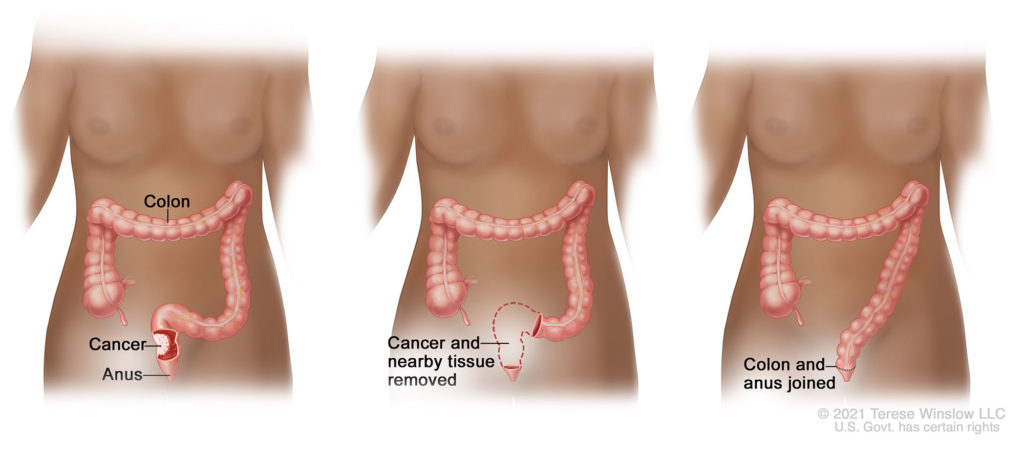

Resection of the Rectum with Anastomosis
As with any surgery, complications can develop. While an ostomy procedure after rectal resection surgery is the current standard of care to provide protection to the healing anastomosis, specific risks are associated with the ostomy operation. The most common of these complications may include:
- Dehydration
- Irritation and inflammation of the skin around the ostomy
- A hernia at the site of the ostomy
Additionally, complications may develop from the secondary surgery 2-6 months later to reverse the ostomy.
In addition to physical complications, ostomy patients may experience an impact to their quality of life, due to:
- Social isolation
- Reduced physical activity and/or intimacy
- Extended recovery after cancer surgery
- Added expense of ostomy supplies
About Colovac1
Colovac is a colorectal anastomosis protection device intended to reduce the contact of fecal content at the anastomotic site following colorectal surgery. The device is placed at the time of the rectal resection surgery and is fully reversible. Colovac is designed to remain in place for up to 12 days, until the body’s natural healing and tissue repair processes are complete in the majority of patients,1 after which it is removed during an endoscopic procedure similar to a colonoscopy, without the need for a second surgical intervention.
For the majority of patients,1 Colovac is expected to eliminate the need for a second surgery. This enables patients to resume normal activity after their cancer resection surgery without the stigma and complications associated with an ostomy procedure.

Rectal Cancer Treatment without Colovac
- Time to Full Recovery: 2-6 months
- 2 Surgeries, 2 Hospital Stays
- Risk of Complications
- 2 Surgeries Under Anesthesia
- Additional Incisions
- Potential Ostomy Complications such as dehydration from high-output stoma2, ileus3, stomal prolapse3,4, wound complications3, parastomal hernia4, necrosis4, stenosis4, and peritonitis4. For a complete list of potential complications, speak with your doctor.
- Risk of Permanent Ostomy
- Quality of Life Due to Ostomy Bag
- Potential Social Isolation
- Impact on Physical Activity and Intimacy
- Added Expense of Ostomy Supplies
- Cost to Patient and Health Care System
- Multiple Surgeries and Hospital Stays
- Time to Full Recovery

Rectal Cancer Treatment with Colovac
- Time to Full Recovery: as little as 2 weeks
- Only 1 Surgery and Hospital Stay for the Majority of Patients2
- Risk of Complications
- Potential Colovac Related Complications such as pelvic abscess or collection, anastomosis leakage, fistula or dehiscence, peritonitis, sepsis, colon perforation, obturation or occlusion, and undesirable side-effects associated with delayed ostomy creation. For a complete list of potential complications, speak with your doctor.
- Single Surgery under Anesthesia2
- No Ostomy Complications
- Patient Satisfaction
- No Ostomy Bag, No Lifestyle Changes for the Majority of Patients2
- Faster Return to Normal Life
- Decreased Cost to Patient and Health Care System6
- Single Surgery and Hospital Stay for the Majority of Patients2
- Reduced Time to Full Recovery
1 Colovac is an investigational device limited by Federal (United States) law to investigational use. Therefore, the risks and benefits have not been assessed by the US Food and Drug Administration (FDA).
2 For a small number of patients, the anastomosis will not be fully healed when the Colovac Device is removed and conversion to an ostomy will be required. Although they will have the same ostomy creation and reversal procedures as patients who did not receive Colovac, they will have an additional exposure to anesthesia and may experience an undesirable side-effect associated with delayed ostomy creation.
3 Waterland P, Goonetilleke K, Naumann DN, Sutcliff M, Soliman F. Defunctioning Ileostomy Reversal Rates and Reasons for Delayed Reversal: Does Delay Impact on Complications of Ileostomy Reversal? A Study of 170 Defunctioning Ileostomies. J Clin Med Res. 2015;7(9):685‐689. doi:10.14740/jocmr2150w
4 Yin, T.C., et al., Early closure of defunctioning stoma increases complications related to stoma closure after concurrent chemoradiotherapy and low anterior resection in patients with rectal cancer. World J Surg Oncol, 2017. 15(1): p. 80.
5 Wu X 2018 Wu X, Lin G, Qiu H, Xiao Y, Wu B, Zhong M. Loop ostomy following laparoscopic low anterior resection for rectal cancer after neoadjuvant chemoradiotherapy. Eur J Med Res. 2018;23(1):24. Published 2018 May 22. doi:10.1186/s40001-018-0325-x
6Surgical Endoscopy, 14 August 2023, Cost associated with diverting ostomy after rectal cancer surgery: a transnational analysis.
06012026
Clinical Partners:
France
Bordeaux Colorectal Institute Clinique Tivoli-Ducos
Bordeaux, France
 Prof. Quentin Denost
CHU de Rouen
Rouen, France
 Prof. Jean-Jacques Tuech
Hôpital Saint-Antoine AP-HP
Paris, France
 Prof. Jérémie Lefevre
Hôpital Saint-Louis AP-HP
Paris, France
 Prof. Léon Maggiori
IHU Institut Hospitalo-Universitaire de Strasbourg
Strasbourg, France
 Prof. Didier Mutter
Belgium
 Prof. Niels Komen
Antwerp University Hospital
Edegem, Belgium
Contact: Isabelle Terrasson
Italy
Istituto Clinico Humanitas
Milan, Italy

1 Colovac and SmartVac are CE-marked per EU MDR 2017-745
06012026